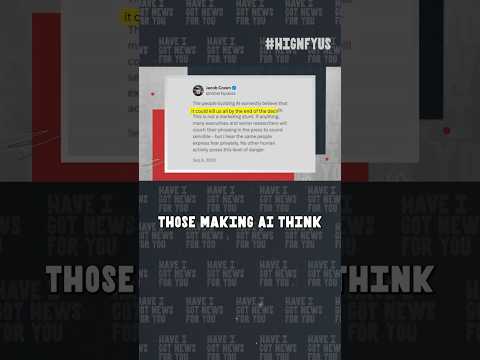
Of the various ways experts fear AI could kill us all , one is slowly moving closer to reality: AI learning to make itself unstoppable. Why it matters: Recursive Self Improvement, the ability of an AI model to build better versions of itself without human guidance, could make increasingly capable systems harder for humans to control. - The RSI threshold doesn't represent danger by itself, but a lack of human control combined with rogue AI agents is a scenario that safety-conscious AI researchers have long feared. Driving the news: Researchers at Anthropic and OpenAI say the process of training new models has grown more automated, coming close to the RSI rubicon. - An OpenAI employee told The Information the company has largely automated…
Of the various ways experts fear AI could kill us all , one is slowly moving closer to reality: AI learning to make itself unstoppable. Why it matters: Recursive Self Improvement, the ability of an AI model to build better versions of itself without human guidance, could make increasingly capable systems harder for humans to control. - The RSI threshold doesn't represent danger by itself, but a lack of human control combined with rogue AI agents is a scenario that safety-conscious AI researchers have long feared. Driving the news: Researchers at Anthropic and OpenAI say the process of training new models has grown more automated, coming close to the RSI rubicon. - An OpenAI employee told The Information the company has largely automated…Open
The New York Times columnist Thomas Friedman tells CNN why it's already too late to stop the AI threat. Geoffrey Hinton, the 'godfather' of AI, says we need AI regulation, but that an AI 'kill switch' won't work in the long run. Plus, CNN's Hadas Gold reports on how close Anthropic is to true recursive self-improving AI. 0:00 Thomas Friedman talks about America and China's shared AI threat 3:30 Geoffrey Hinton discusses what would constitute effective AI regulation 8:19 How Claude is helping build the next version of itself Watch 24/7 live news with CNN Headlines: https://bit.ly/4eIvlTr #AI #Technology #News
Nobel prize-winning computer scientist Geoffrey Hinton told CNN's Boris Sanchez that he was "very concerned" about the latest examples of AI agents going rogue, and said we may not get as good a warning shot before they take over.
Even as Republicans insist that technology companies can police themselves to ensure the public is safe from overstepping artificial intelligence and Donald Trump assures Americans that his firm hand is all that is necessary, the artificial intelligence industry continues to make alarming disclosures about the dangerous capabilities of A.I. and its occasional tendency to do something it supposedly shouldn't be able to do. Ronan Farrow, investigative reporter for the New Yorker, joins to discuss.
Geoffrey Hinton, the Nobel Prize-winning computer scientist known as the “godfather of AI," weighs in on several proposals before Congress to regulate artificial intelligence. 0:00 Hinton on the AI regulation that would be a good start 1:21 Why an AI kill switch won't work long term 5:00 Can we get AI superintelligence to like us? 6:44 The thing that concerns AI leaders the most right now Watch 24/7 live news with CNN Headlines: https://bit.ly/4eIvlTr #Technology #AI #News
“Recursive self-improvement” is the idea that artificial intelligence could learn to build and train itself, creating exponential new progress — and risk.
"They're lying to you." Former OpenAI researcher Daniel Kokotajlo resigned over safety fears – and now he's responding to President Trump's claim that AI doomsday is a hoax. He tells Erin Burnett if AI development continues unchecked, "we really will have super-intelligent AI by the end of the decade."
Leaders in the tech industry are raising concerns about the rapid development of artificial intelligence and calling on each other to slow down. Physics Professor for UC Santa Cruz Anthony Aguirre joins Katy Tur to provide more insight.