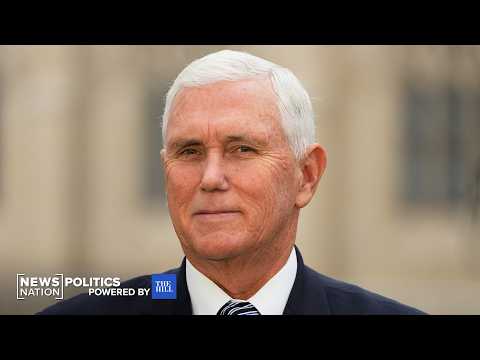
Pence praises Trump's decision to confront Iran but warns against any agreement that would leave the regime's nuclear or missile programs intact. He argues that "no deal is better than a bad deal" and outlines what he believes must happen to secure long-term peace and stability in the Middle East.
On Thursday evening, President Trump called Israeli Prime Minister Benjamin Netanyahu with news he did not want to hear: He expected to sign a deal with Iran within days. - "This is the deal. It's a great deal, and it's time to end this war," Trump told Netanyahu, according to a senior U.S. official. Why it matters: When Netanyahu went to war alongside Trump, this is not how he envisioned it ending. Flashback: Netanyahu made clear from the beginning that he believed the war could spur regime change in Tehran. Now, four months out from an election, Netanyahu's rivals are accusing him of making Israel a "vassal state" by simply accepting Trump's terms for peace. - Some in Washington think Netanyahu might play a spoiler role even if the…
President Trump’s boasts of securing a commitment from Iranian leaders not to develop a nuclear weapon have puzzled nuclear experts who note that Tehran has made that pledge for more than 50 years.
We are at war with Iran. Meanwhile, we are supplying Iran with hard cash to keep it afloat. This is how it works. Ever since 2003, the U.S. Federal Reserve has been shipping pallets of cash to Iraq. Iraqi oil revenues are typically deposited into the Federal Reserve Bank of New York, and in exchange, because Iraq’s economy is heavily cash-based, we send physical U.S. currency to the Central Bank of Iraq. We send a lot of cash, sometimes as much as $13 billion a year. Once in Iraq, a substantial portion of this money is diverted or smuggled into Iran, particularly through Iran-backed militias and informal networks. These pro-Iranian groups access the cash via auctions, banks, fake invoices, and prepaid debit card schemes. Once physical…Open
The U.S. is reportedly awaiting Iran’s response to a 14-point plan that would permanently cease hostilities and establish a framework for future talks on the nuclear aspect.
The Treasury Department announced penalties on 10 entities and individuals accused of helping Iran obtain materials for its missile program, while the State Department sanctioned four additional entities it said provided satellite imagery used in strikes on U.S. forces in the Middle East. On Capitol Hill, lawmakers remain divided. NewsNation's Jackie Koppell has more. Start your day with "Morning in America," NewsNation's live three-hour national weekend morning newscast hosted by Hena Doba. Saturday and Sunday starting at 7a/6C. #MorningInAmerica NewsNation is your source for fact-based, unbiased news for all Americans.
The current war is already collapsing into a “mowing the grass” strategy. The post The United States Is Already Headed for a Forever War appeared first on The American Conservative .
Foreign Affairs The United States Is Already Headed for a Forever War The current war is already collapsing into a “mowing the grass” strategy. Let’s all give a hand for Marco Rubio, secretary of state, favored champion of the White House, and all-around cretinous worm. The Amazing Plastic Man—the adjective refers to his flexible principles, not his increasingly inflexible face—was hitting the airwaves this Monday morning to articulate the latest version of what the Trump administration regards as its war aims. Excuse me, military operation aims; President Donald Trump has figured out the One Weird Trick around…Open
Nearly a month into the Iran war , there are signs the conflict is poised to expand rather than conclude. The big picture: Potential future events in the war — like escalation in the Strait of Hormuz or major changes Iran's leadership — could determine when the conflict ends. - The U.S. and Israel also have contrasting visions of the endgame, with Israel willing to endure more chaos to destabilize the regime, officials told Axios . - "Our objectives are our objectives," Secretary of Defense Pete Hegseth said last week. "We'll set the tempo of when those are met." Here are four pivotal questions that could shape the war's next phase. What happens to the Strait of Hormuz? A major question surrounding the war right now is what happens…
President Trump and Bibi Netanyahu have spoken almost every day since the war began. Trump told Axios that they're "working great together." - But U.S. officials realize the two countries' endgames and risk tolerance may diverge as the 19-day-old war continues. Why it matters: Several U.S. officials described Trump as the most bullish person in the White House on going to war with Iran. He also appears more aligned with Netanyahu's maximalist objectives than many of his aides. Officials in Washington, Tel Aviv and Tehran all know any split between the allies could define the outcome of the war. - Three of President Trump's advisers tell Axios they believe he'll want to end major operations before Israeli Prime Minister Benjamin…