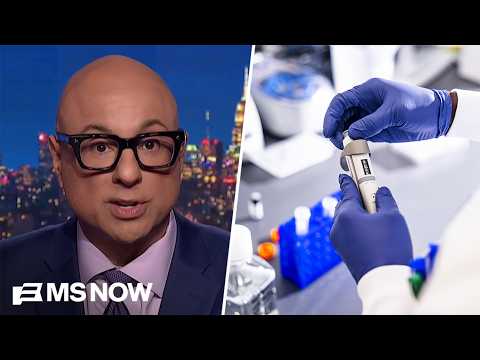
Personalized vaccines could be around the corner thanks to decades of work by doctors like Michelle Wu. Her story and details on the new breakthrough on tonight's 11th Hour with Ali Velshi.
My wife, Autumn, has spent nearly a quarter of the past four years in ERs and hospitals, untangling and battling three chronic conditions — and a shamefully broken U.S. medical system. - We live in Washington, D.C., with top-rated hospitals in our backyard. Yet her experience has been eye-opening and often horrifying, especially for a nation that spends twice as much on medical care as our rivals. What it's like: ERs so hauntingly jammed she's often stacked like cargo in hallways, on a stretcher, waiting double-digit hours for care. - Well-intentioned and often talented nurses overwhelmed and overworked. - Doctors forbidden from, or uninterested in, working with experts beyond their domain to solve complex conditions. It's random luck…
My wife, Autumn, has spent nearly a quarter of the past four years in ERs and hospitals, untangling and battling three chronic conditions — and a shamefully broken U.S. medical system. - We live in Washington, D.C., with top-rated hospitals in our backyard. Yet her experience has been eye-opening and often horrifying, especially for a nation that spends twice as much on medical care as our rivals. What it's like: ERs so hauntingly jammed she's often stacked like cargo in hallways, on a stretcher, waiting double-digit hours for care. - Well-intentioned and often talented nurses overwhelmed and overworked. - Doctors forbidden from, or uninterested in, working with experts beyond their domain to solve complex conditions. It's random luck…Open
At 37, Alex was fit, healthy and working as a geneticist. Then he received a shocking diagnosis: stage 4 rectal cancer that had spread to his liver. In this episode of "Greta Wire," Greta Van Susteren sits down with Alex to hear how his symptoms began, why his cancer proved difficult to detect, and what it has been like undergoing radiation, chemotherapy, surgery and immunotherapy while still in his 30s. Alex also brings a unique perspective to his diagnosis. With a background in computational biology and statistical genetics, he has spent his career studying how genes influence disease — yet extensive testing has revealed no known genetic explanation for his own colorectal cancer. Now Alex is pursuing another option: an experimental…
- Alex Young, a 37-year-old UCLA genetics researcher, opens up about his stage 4 colorectal cancer diagnosis despite having no known family history or identifiable genetic risk. - Young describes months of warning signs, a false-negative blood test and delayed colonoscopy before doctors discover rectal cancer that has spread to his liver. - After chemotherapy, radiation and surgery, Young turns to next-generation immunotherapy while confronting the physical and emotional toll of fighting cancer at such a young age. - A GoFundMe campaign raises roughly $120,000 in a matter of hours, allowing Young to pursue a personalized cancer vaccine designed around the unique mutations in his tumor. - Young explains how personalized cancer vaccines…
A new nonprofit wants to streamline gene therapy for diseases often avoided by pharmaceutical companies — making treatment more like a routine procedure than a bespoke drug.
Firms like Function Health and Oura market regular blood tests to people wanting to take their health into their own hands. The process often raises more questions for patients than it can answer.
Firms like Function Health and Oura market regular blood tests to people wanting to take their health into their own hands. The process often raises more questions for patients than it can answer.Open
As doctors learn why GLP-1s don't work for about 50% of people, they are also learning more about the complex drivers of obesity. They foresee a future of personalized obesity medicine similar to the way cancer is treated now.
As doctors learn why GLP-1s don't work for about 50% of people, they are also learning more about the complex drivers of obesity. They foresee a future of personalized obesity medicine similar to the way cancer is treated now.Open